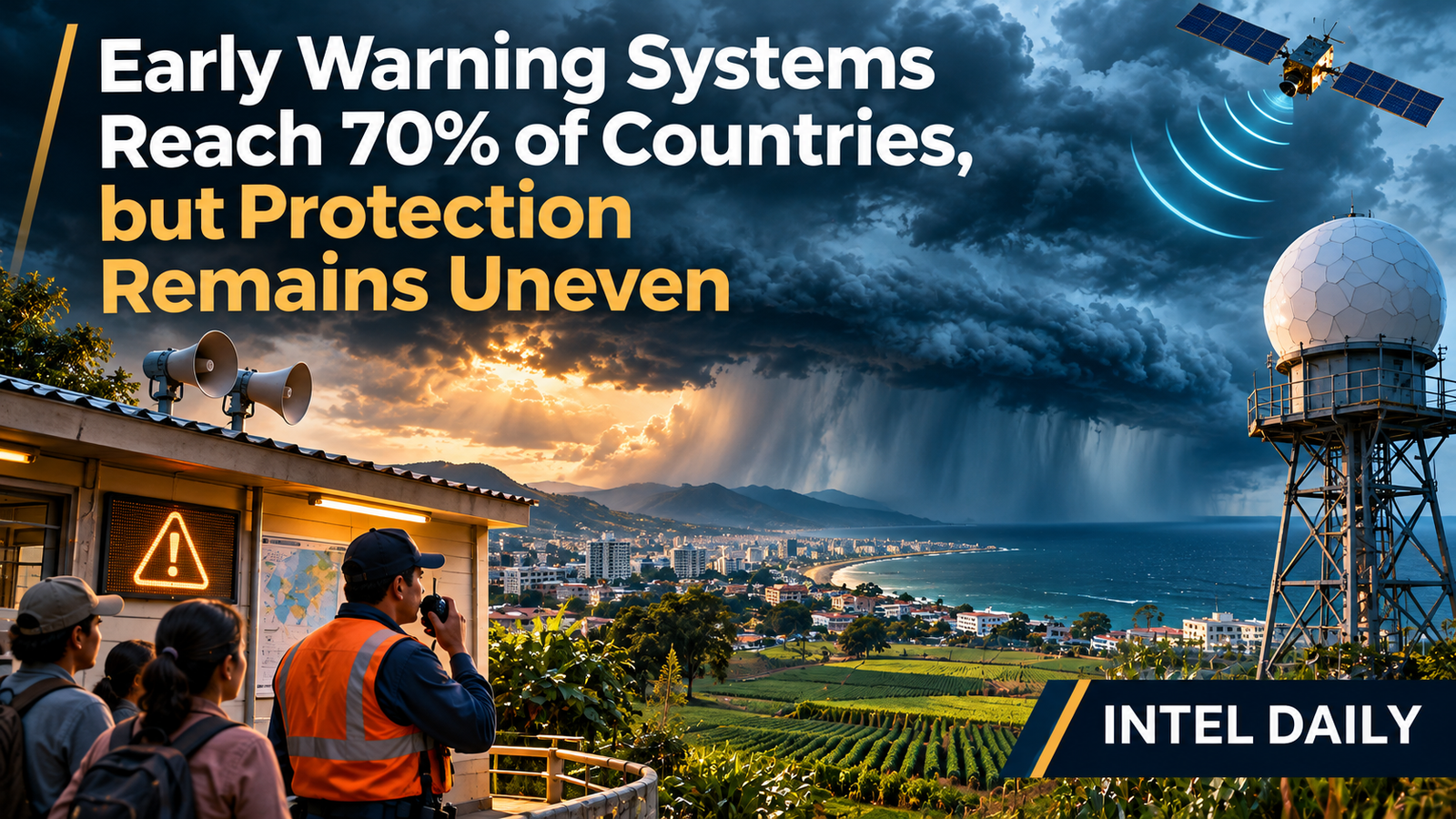
Early Warning Systems Reach 70% of Countries, but Protection Remains Uneven

A new UN assessment says disaster alerts are spreading, yet the countries most exposed to climate shocks still face significant gaps between forecasts and effective action.
More countries now have systems to warn residents about extreme weather and other natural hazards, but the global expansion masks a persistent problem: the communities most vulnerable to disasters are often the least able to act on an alert.
A joint World Meteorological Organization and United Nations Office for Disaster Risk Reduction report released on November 11 at the COP31 climate summit in Antalya finds that 136 countries, or 70% of countries worldwide, report some multi-hazard early-warning capability. That is 17 more than in March 2025 and represents a 143% increase since reporting began in 2015.
The new figures show progress toward the UN’s Early Warnings for All initiative. They do not mean that 70% of people have comprehensive protection, or that every warning reliably reaches households in danger.
Coverage is only the first test
According to the 2026 assessment, fewer than half of reporting countries demonstrate capability across all four essential pillars: understanding risks, monitoring hazards, communicating warnings and preparing an effective response.
The report identifies a strong association between more developed systems and better outcomes. Countries with substantial or comprehensive capabilities recorded disaster-related mortality 6.1 times lower, and 3.2 times fewer people affected, than those with limited or moderate systems. Those comparisons are not proof that warning systems alone produced the difference; wealth, infrastructure and emergency services also affect outcomes.
Small island developing states report the lowest coverage, while least developed countries score lowest for overall comprehensiveness. The location of those gaps matters as rising sea levels and weather extremes expose populations with relatively limited fiscal resources.
From a forecast to action
An alert is useful only when people receive, understand and can respond to it. Flood warnings may require functioning mobile networks, trusted local messengers, evacuation transport and safe shelters. Drought alerts need a different chain of decisions, including farmers’ access to information and support.
The UN agencies say active anticipatory-action frameworks increased from 154 to 262 in 2025 across 75 countries. Some 146 activations reached 9.6 million people, supported by $119.9 million in prearranged financing. That funding is for recorded activations, not the total price of building global warning infrastructure.
Cell-broadcast technology is expanding: 38 countries had fully operational systems by June 2026, with 17 more nearing deployment. Technology can improve reach, but maintenance, language accessibility and local trust remain crucial.
A difficult climate test
The WMO’s State of the Climate update says an intensifying El Niño could bring heightened heat, drought and heavy-rainfall risks into 2027. Such shocks can undermine schools, farming and transport before emergency responders arrive.
UNICEF and Save the Children estimate that more than 347 million children live in areas forecast to experience unusually wet or dry conditions in late 2026. Their education guidance calls for contingency plans that keep learning accessible when hazards strike.
The next measure of success
For governments and investors, counting national systems should be a starting point rather than the final metric. A better scorecard would track how quickly warnings travel, whether vulnerable households can act, and what happens after alerts are issued.
The 2026 report demonstrates that the global warning network is growing. Its central challenge is to convert that network into practical protection before the next disaster tests it.